Materialism by Terry Eagleton
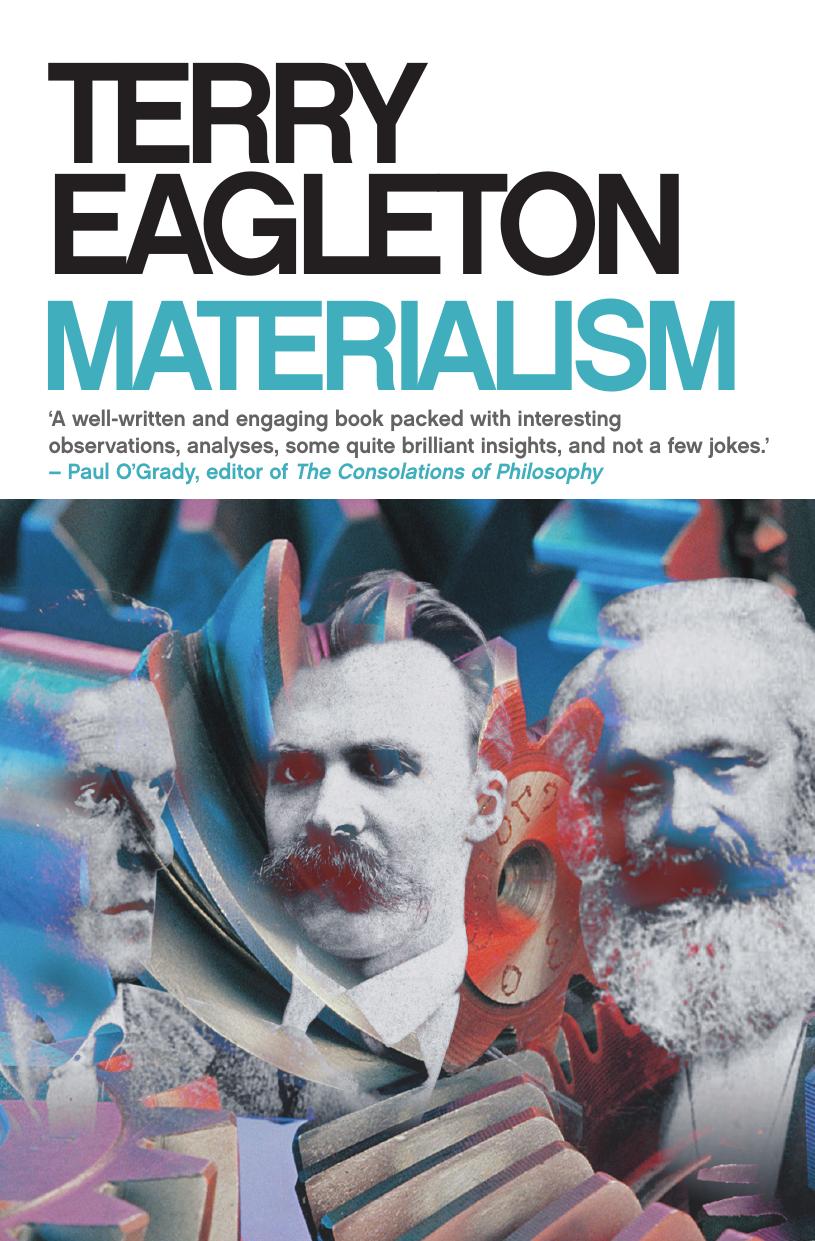
Author:Terry Eagleton [Eagleton, Terry]
Language: eng
Format: epub, pdf
Tags: Philosophy, History & Surveys, Modern, Criticism
ISBN: 9780300218800
Google: MyDPjwEACAAJ
Amazon: 030021880X
Publisher: Yale University Press
Published: 2017-01-25T21:00:00+00:00
CHAPTER FOUR
High Spirits
MARX AND NIETZSCHE form such a political contrast that it is easy to overlook how much they have in common. Both are materialists for whom the noble has its origins in the base. Both view knowledge as essentially practical, grounding it in the body. For Marx, knowledge in class-society is largely in the service of power, while for Nietzsche it fulfils that role at all times and in all places. Indeed, power is a central motif for them both, though Nietzsche regards it as the ultimate reality, while Marx holds to something more fundamental still, namely the material interests which power protects or contests. He might well have dismissed Nietzsche’s exuberant vision of the world as will to power – as a place where every material body strives to grow and flourish by exercising dominion over others – as a kind of cosmic capitalism. ‘Life itself,’ Nietzsche writes, ‘is essentially appropriation, injury, overpowering of what is alien and weaker; suppression, hardness, imposition of one’s own forms, incorporation and at least, at its mildest, exploitation.’1 To the pious bourgeois who throws up his hands in horror at this vision, Nietzsche’s response is: look at the beliefs inherent in your own everyday behaviour. Look at what you do in your counting house, not at what you intone in church.
Both men are wary of the consolations of idealism. Both see false consciousness as afflicting the great mass of humanity – temporarily so for Marx, permanently so for Nietzsche. In their resolute this-worldliness, they reject all metaphysical fictions and bogus spirituality. Both suspect altruism and humanitarianism of cloaking the harsh realities of exploitation. They are also, in Nietzsche’s word, ‘immoralists’, refusing to treat morality as an autonomous sphere of its own and insisting on its role in a broader material history. That they are historicists is another of their affinities. Nietzsche may not be a historical materialist, but his thought is both historical and materialist. The two authors’ views of history are also in some ways parallel. By and large, the human saga has been for both men a bloodstained narrative of violence, conflict and oppression – though Marx discerns an intelligible pattern in this tale, while Nietzsche calls it ‘a gruesome dominion of nonsense and accident’.2
For Marx, we can advance into the future only by recollecting the trauma of the past; for Nietzsche, we can march forward only by a kind of heroically willed amnesia. Both thinkers, however, are convinced that the wretched history of humankind can be overcome – for Marx by communism, for Nietzsche by the advent of the Overman (Übermensch). In both cases, the seeds of this transcendence are already being sown – and sown, ironically, in the very misfortunes of the present. What Nietzsche calls the moral era is the chronicle of humanity’s self-torment and self-loathing; yet by refining and spiritualising human beings, this cheerless condition lays the ground for a choice few of them to become as gods. Marx has a more universal redemption in his
Download
This site does not store any files on its server. We only index and link to content provided by other sites. Please contact the content providers to delete copyright contents if any and email us, we'll remove relevant links or contents immediately.
The Brazilian Economy since the Great Financial Crisis of 20072008 by Philip Arestis Carolina Troncoso Baltar & Daniela Magalhães Prates(368765)
International Integration of the Brazilian Economy by Elias C. Grivoyannis(111628)
The Art of Coaching by Elena Aguilar(53695)
Flexible Working by Dale Gemma;(23364)
How to Stop Living Paycheck to Paycheck by Avery Breyer(19839)
Thinking, Fast and Slow by Kahneman Daniel(12549)
The Acquirer's Multiple: How the Billionaire Contrarians of Deep Value Beat the Market by Tobias Carlisle(12438)
The Radium Girls by Kate Moore(12210)
The Art of Thinking Clearly by Rolf Dobelli(10734)
Hit Refresh by Satya Nadella(9267)
The Compound Effect by Darren Hardy(9173)
Tools of Titans by Timothy Ferriss(8616)
Atomic Habits: Tiny Changes, Remarkable Results by James Clear(8532)
Turbulence by E. J. Noyes(8230)
A Court of Wings and Ruin by Sarah J. Maas(8127)
Change Your Questions, Change Your Life by Marilee Adams(7943)
Nudge - Improving Decisions about Health, Wealth, and Happiness by Thaler Sunstein(7866)
How to Be a Bawse: A Guide to Conquering Life by Lilly Singh(7635)
Win Bigly by Scott Adams(7353)
